3 Oct, 2025

Ask Nicole: Program Updates Take Time—and That’s Okay

By |2025-10-03T13:09:08-04:00October 3rd, 2025|Categories: Program, Service, & Campaign Design|Tags: , , , , |0 Comments

Close-up photo of Nicole Clark smiling confidently, framed by a bold purple border. White text at the top reads “Ask Nicole,” and a purple banner across the middle displays the blog title: “Program Updates Take Time—And That’s Okay.” The Nicole Clark Consulting logo appears at the bottom with the tagline “Raise Your Voice for Women & Girls of Color.”
Have a question you’d like to be featured? Let me know.

I’ve talked about the moment when you realize your program’s design is outdated. Maybe the content hasn’t evolved in years. Maybe it no longer reflects your participants’ realities. Or maybe the logic model hasn’t been updated despite changing the program’s activities.

Since then, I’ve heard from many of you:

We know our program isn’t where it should be… but we’re already stretched so thin.
We want to make updates, but we don’t even know where to begin.
We feel stuck—even though we’re clear something needs to change.

If this resonates with you and your staff, you’re not alone.

Program updates take time—and that’s okay.

(more…)
24 Sep, 2025

Making Sense Together: Community-Led Data Interpretation in Practice

By |2025-09-24T12:26:53-04:00September 24th, 2025|Categories: Research & Evaluation|Tags: , , , |0 Comments

Three women sit together in a casual meeting space, smiling and discussing notes. A gold banner at the top reads “Try This.” A second banner reads: “Making Sense Together: Community-Led Data Interpretation in Practice.” At the bottom is the Nicole Clark Consulting logo with the tagline “Raise Your Voice for Women & Girls of Color.”
Try this out and let me know how it goes for you.

Collecting data is only one part of the research process. The real power lies in how that data is interpreted, understood, and applied. Too often, interpretation is treated as an internal task—reserved for staff, consultants, or funders—while the communities who shaped the data are left out of the conversation.

When we open up the analysis phase to include participants, we gain context, nuance, and insights that transform findings from raw numbers into lived truths. This is where research shifts from being about communities to being with them.

Objective:

To engage community members in collaboratively interpreting research findings and generating insights that reflect their lived experiences.

This activity is ideal for:

  • Organizations conducting surveys, focus groups, or interviews with community members
  • Teams wanting to check assumptions and ensure findings resonate with participants’ realities
  • Coalitions or partnerships looking to build trust and deepen community ownership of data

What you’ll need:

  • A set of preliminary findings (e.g., survey results, themes from interviews, charts, or quotes)
  • Simple presentation materials (slides, posters, or handouts with visuals)
  • Markers, sticky notes, or virtual collaboration tools (if online)
  • 60–90 minutes of meeting time
  • A facilitator comfortable guiding group discussions
(more…)
20 Aug, 2025

Try This: The Data-Driven Decision Tree Walk-Through

By |2025-08-20T10:11:47-04:00August 20th, 2025|Categories: Program, Service, & Campaign Design|Tags: , , , , |0 Comments

A close-up of a person’s hands writing with a pen on paper. The image has a gold border with white text at the top that says “Try This” and gold text in the center that reads, “The Data-Driven Decision Tree Walk-Through.” At the bottom, the Nicole Clark Consulting logo and tagline appear.
For access to the full activity, sign up for my newsletter.

Staff want to engage with data-driven decision making, but they don’t always have the time or space to do so.

When organizational leaders make decision-making processes transparent and collaborative, it supports staff, even if they can’t act on every idea right away.

This week, we’ll take a more hands-on approach. I’ll walk you through an activity you can use with your team to turn raw data into clear, actionable insights: The Data-Driven Decision Tree. 

The Data-Driven Decision Tree is one of two activities taken from “Prioritize This: Data-Driven Decision Making“, a free resource provided to my newsletter subscribers. This activity helps break down program and service evaluation data into actionable steps based on feasibility and impact.

Objective:

Help your team turn data into clear, actionable next steps by exploring feasibility, mission alignment, and participant impact.

This activity is ideal for:

  • Staff who design and implement programs
  • Leadership responsible for strategic decisions
  • Any staff who collect, analyze, or share participant feedback

What you’ll need:

  • A copy of the Data-Driven Decision Tree. (Sign up for my newsletter to access the full exercise (including the decision tree visual) from Prioritize This: Data-Driven Decision Making.)
  • Program or evaluation data you want to analyze
  • A notetaker or facilitator to guide discussion
  • Time allotted: 30–45 minutes, depending on group size and number of data points

The steps:

(more…)
13 Aug, 2025

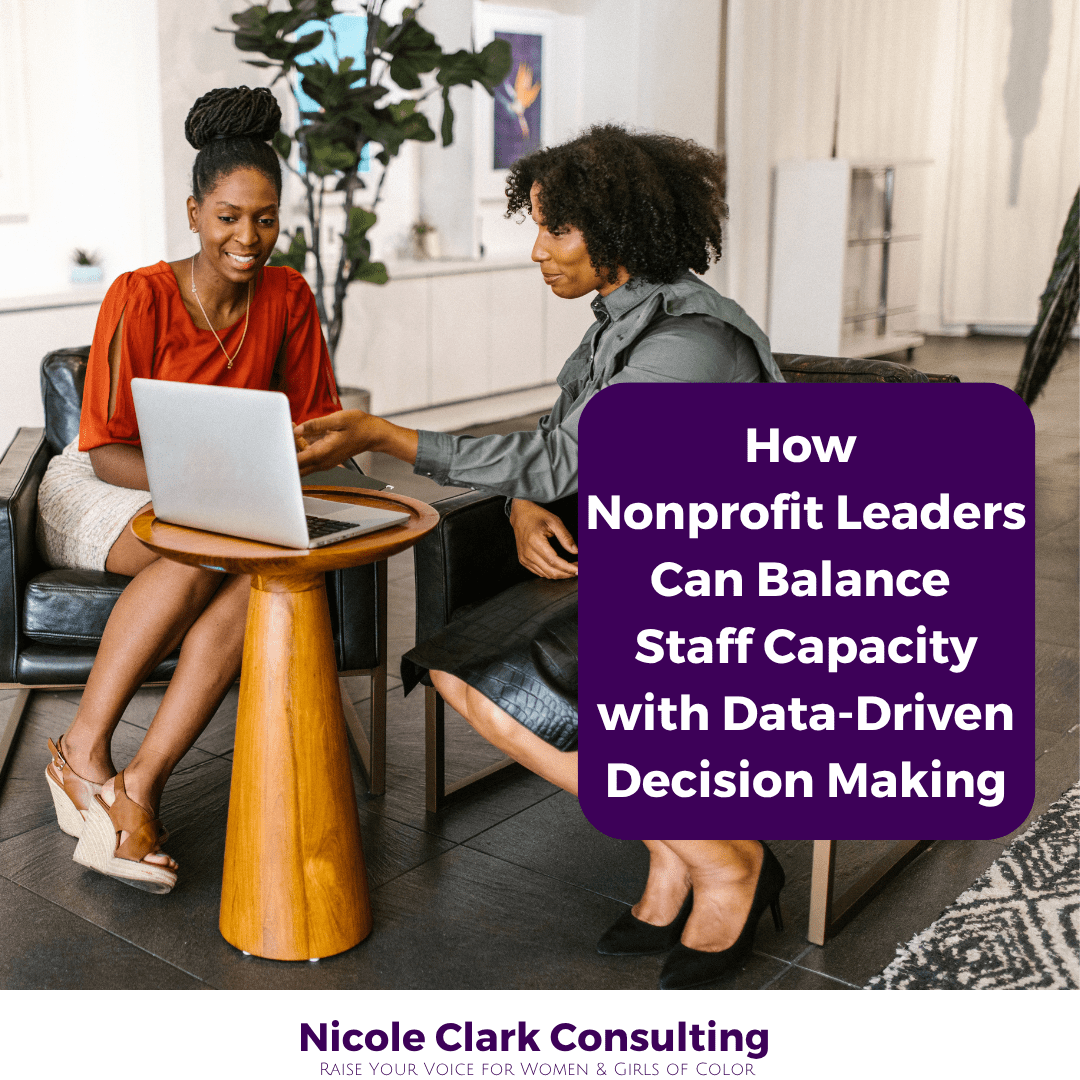
How Nonprofit Leaders Can Balance Staff Capacity with Data-Driven Decision Making

By |2025-08-13T14:26:37-04:00August 13th, 2025|Categories: Program, Service, & Campaign Design|Tags: , , , |0 Comments

Two Black women sit together in a modern office space, smiling and looking at a laptop. A purple text box reads, “How Nonprofit Leaders Can Balance Staff Capacity with Data-Driven Decision Making.” The image is branded with Nicole Clark Consulting’s logo and tagline, “Raise Your Voice for Women & Girls of Color.”
Here’s how to balance both without sacrificing impact.

In my last post, we explored the tension between wanting to engage with data-driven decision making and not having the space or capacity to do so.

Many staff want to think strategically, but without dedicated time and structural support, evaluation efforts become something that’s outsourced rather than embedded in organizational culture.

Nonprofit leaders play a critical role in shifting this dynamic by creating conditions where evaluative thinking is not just a one-off activity, but part of everyday decision-making.

In this post, we’ll look at how to navigate two realities: first, the emotional weight of setting aside important but currently unfeasible changes, and second, the value of making the decision-making process transparent and collaborative. Along the way, I’ll also pose two key reflection questions for leaders to use with their teams—questions that can help staff focus their energy where it matters most.

(more…)
6 Aug, 2025

Ask Nicole: We’re Too Busy for Data-Driven Decision Making

By |2025-08-07T16:46:23-04:00August 6th, 2025|Categories: Program, Service, & Campaign Design|Tags: , , , , |0 Comments

A smiling Black woman wearing a yellow top and gold earrings, is framed by a purple border. The text reads: "Ask Nicole — We're Too Busy for Data-Driven Decision Making." The image is branded with "Nicole Clark Consulting – Raise Your Voice for Women & Girls of Color."
Have a question you’d like to be featured? Let me know.

In nearly every monitoring and evaluation (M&E) project I’ve supported (whether it’s building a M&E framework or helping teams with data sense making) there comes a moment, often near the end, when staff reflect candidly.

It’s a quiet acknowledgment of a very real tension: Staff see the value in evaluative thinking, but day-to-day programming demands of don’t allow them the time or space to engage with it meaningfully.

They’re not admissions of disinterest or resistance—they’re reminders of what it means to be inside a maxed-out organization.

Evaluation becomes something that’s outsourced to an external evaluator. Not because staff wants it to be, but because there’s no room to slow down, reflect, and strategize as a team.

And yet, the more you push data work to the margins, the more disconnected it becomes from the real day-to-day decision making.

Here’s how organizational leadership can make space for data-driven decision making—even when it feels like there’s none to spare.

(more…)

This Is A Custom Widget

This Sliding Bar can be switched on or off in theme options, and can take any widget you throw at it or even fill it with your custom HTML Code. Its perfect for grabbing the attention of your viewers. Choose between 1, 2, 3 or 4 columns, set the background color, widget divider color, activate transparency, a top border or fully disable it on desktop and mobile.
Go to Top