15 Jul, 2026

The Messy Middle Is Where Change Happens
By |2026-07-15T14:52:40-04:00July 15th, 2026|Categories: Strategic Planning & Sustainability|Tags: , , |0 Comments

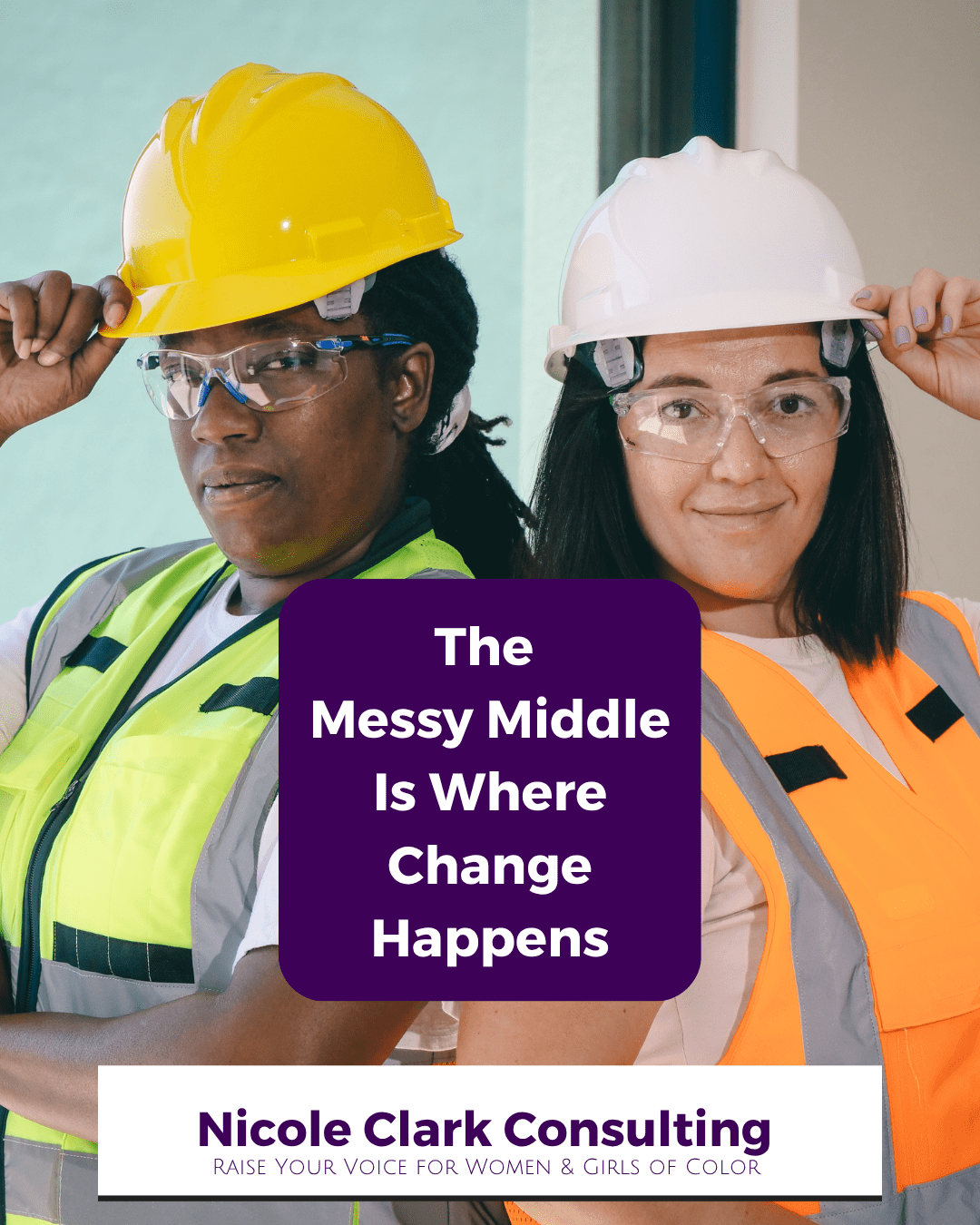
Two construction workers wearing hard hats, safety glasses, and reflective vests stand side by side. A purple text box over the image reads, "The Messy Middle Is Where Change Happens." The bottom of the graphic displays "Nicole Clark Consulting" and the tagline, "Raise Your Voice for Women & Girls of Color."
Just as every building requires a construction phase, meaningful organizational change requires navigating the messy middle.

Whether we’re talking about city infrastructure, nonprofit initiatives, strategic plans, or organizational change, every project eventually enters what I call the messy middle.

It’s that period between making a decision and achieving the desired outcome. It’s where leaders begin implementing new ideas, organizations adjust to change, and communities start experiencing the effects of decisions.

The messy middle looks different everywhere. For a city, it may involve years of construction, traffic detours, and public frustration before a new transit line opens. For a nonprofit, it might mean adjusting programs, navigating staff turnover, or refining a new strategy after receiving community feedback. For foundations, implementation often requires patience as grantees test approaches, learn from setbacks, and adapt to changing circumstances. I’ve watched organizations move from an exciting strategic planning process to the far more difficult work of prioritizing recommendations, reallocating resources, and making difficult decisions.

This stage rarely receives the same attention as launching a new initiative or celebrating its success, but it’s where meaningful change actually takes shape.

(more…)
8 Jul, 2026

Ask Nicole: Are We Planning Too Much?

By |2026-07-15T12:14:08-04:00July 8th, 2026|Categories: Strategic Planning & Sustainability|Tags: , , , |0 Comments

A purple "Ask Nicole" blog graphic featuring Nicole Clark smiling in a yellow blouse. The headline reads, "Are We Planning Too Much?" The bottom of the graphic displays "Nicole Clark Consulting" and the tagline, "Raise Your Voice for Women & Girls of Color."
Have a question you’d like to be featured? Let me know.

I recently watched a YouTube video called Why American Cities Can’t Build Anythingand I noticed how it mirrors what I’ve experienced over the past decade as a consultant working with nonprofits and foundations.

One quote from the video especially stood out to me:

“Around the United States, cities have become trapped in an endless cycle of visioning, planning, designing, consulting, studying, and redesigning, all while struggling to build meaningful change that they set out to achieve… planning has become a substitute for action.”

Organizations often hire consultants to facilitate strategic planning, conduct evaluations, lead community engagement, facilitate listening sessions, and make sense of complex issues. These services are valuable. Organizations should take time to understand the problems they’re trying to solve before investing resources into solutions.

At what point does planning delay action?

To be fair, there are important historical reasons why planning often takes longer today than it did decades ago.

Communities have learned, often through painful experiences, what can happen when governments, planners, and developers move projects forward without community input. Those decisions have displaced entire neighborhoods. Public investments have overlooked the people most affected by them. Large institutions and corporations no longer receive the same level of unquestioned trust they once did. As a result, community engagement, public participation, and transparency have become essential parts of planning processes. That’s a good thing.

The challenge is ensuring that planning still serves its original purpose: Helping us make better decisions and move toward implementation.

(more…)
24 Sep, 2025

Making Sense Together: Community-Led Data Interpretation in Practice

By |2025-09-24T12:26:53-04:00September 24th, 2025|Categories: Research & Evaluation|Tags: , , , |0 Comments

Three women sit together in a casual meeting space, smiling and discussing notes. A gold banner at the top reads “Try This.” A second banner reads: “Making Sense Together: Community-Led Data Interpretation in Practice.” At the bottom is the Nicole Clark Consulting logo with the tagline “Raise Your Voice for Women & Girls of Color.”
Try this out and let me know how it goes for you.

Collecting data is only one part of the research process. The real power lies in how that data is interpreted, understood, and applied. Too often, interpretation is treated as an internal task—reserved for staff, consultants, or funders—while the communities who shaped the data are left out of the conversation.

When we open up the analysis phase to include participants, we gain context, nuance, and insights that transform findings from raw numbers into lived truths. This is where research shifts from being about communities to being with them.

Objective:

To engage community members in collaboratively interpreting research findings and generating insights that reflect their lived experiences.

This activity is ideal for:

  • Organizations conducting surveys, focus groups, or interviews with community members
  • Teams wanting to check assumptions and ensure findings resonate with participants’ realities
  • Coalitions or partnerships looking to build trust and deepen community ownership of data

What you’ll need:

  • A set of preliminary findings (e.g., survey results, themes from interviews, charts, or quotes)
  • Simple presentation materials (slides, posters, or handouts with visuals)
  • Markers, sticky notes, or virtual collaboration tools (if online)
  • 60–90 minutes of meeting time
  • A facilitator comfortable guiding group discussions
(more…)
17 Sep, 2025

Close the Loop: Sharing Research Findings with Communities

By |2025-09-17T11:42:12-04:00September 17th, 2025|Categories: Research & Evaluation|Tags: , , |0 Comments

A smiling Black woman with curly hair looks down at a tablet, standing next to another person whose hands are visible. A purple text box reads: “Close the Loop: Sharing Research Findings with Communities.” At the bottom is the Nicole Clark Consulting logo with the tagline “Raise Your Voice for Women & Girls of Color.”

Too often, the research process ends after data are collected, analyzed, and published.

Reports are sent to funders, findings are tucked away in shared drives, and life moves on. But for the people who make the research possible (community members who gave their time, their experiences, and their stories) silence can feel like a betrayal. They opened up, often about deeply personal or vulnerable experiences, and are left wondering what came of it all.

If communities only hear from you when you need data, but not when it’s time to share results, you’re not engaging in true partnership. You’re extracting.

Reporting back to share research findings isn’t just a courtesy. It’s a commitment to respect, reciprocity, and relationship-building.  When we think about equitable research practices, how can we close the loop?

(more…)
15 Jan, 2025

Collaborations that Work: Engaging Schools, Families and Communities

By |2025-01-15T11:12:51-05:00January 15th, 2025|Categories: Program, Service, & Campaign Design|Tags: , |0 Comments


Programs don’t exist in a vacuum.

When everyone —schools, families, and community organizations — pitches in, your program increases its chances of achieving its outcomes. By intentionally finding ways for everyone to work together, you create a team that highlights unique strengths, helping to lift the whole program for more exposure, results, and sustainability. 

Let’s break down how this can look:

(more…)

This Is A Custom Widget

This Sliding Bar can be switched on or off in theme options, and can take any widget you throw at it or even fill it with your custom HTML Code. Its perfect for grabbing the attention of your viewers. Choose between 1, 2, 3 or 4 columns, set the background color, widget divider color, activate transparency, a top border or fully disable it on desktop and mobile.
Go to Top